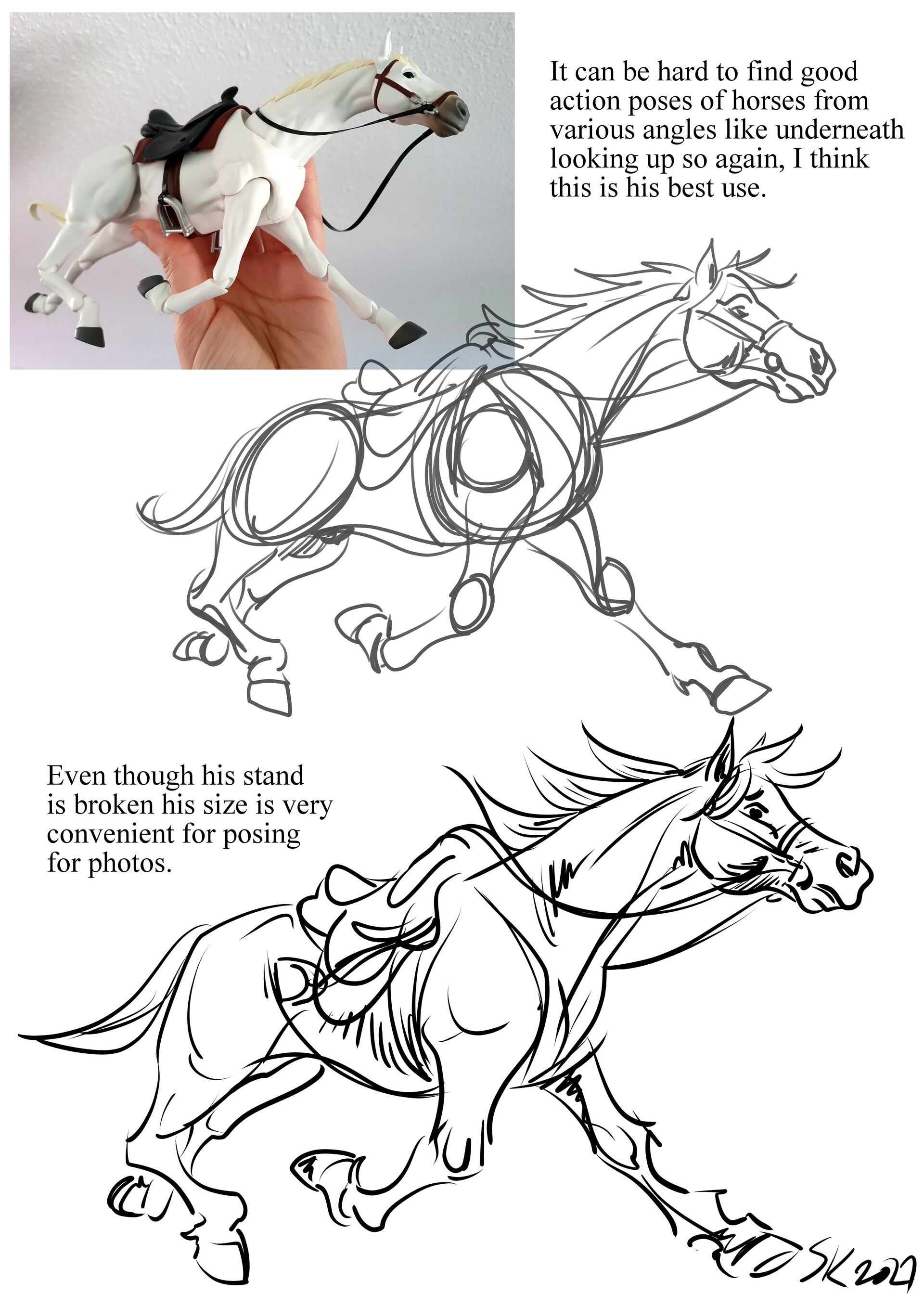
This is a review for the second version of the Figma horse action figure. I bought mine from Total Otaku Mode last November in 2020. Thanks to shipping delays from COVID I only received him in June of 2021. I've spent the last two weeks playing with him and I have some opinions.
I'm an illustrator and comic book artist who grew up riding and working with horses on a farm. I really enjoy drawing horses and incorporating horses and equine creatures into my comics and illustration. At the time of writing this review I'm working on a book about drawing horses for comics and illustrators. I have a small collection of model horses and a photo collection that I used to bolster my personal experience. In addition to this text review on my blog I've also uploaded a YouTube video where I cover a lot of these points. In this review I'll cover what I think are the pros and cons of this model and how I think he can best be used and provide some examples of my own work in Clip Studio Paint.

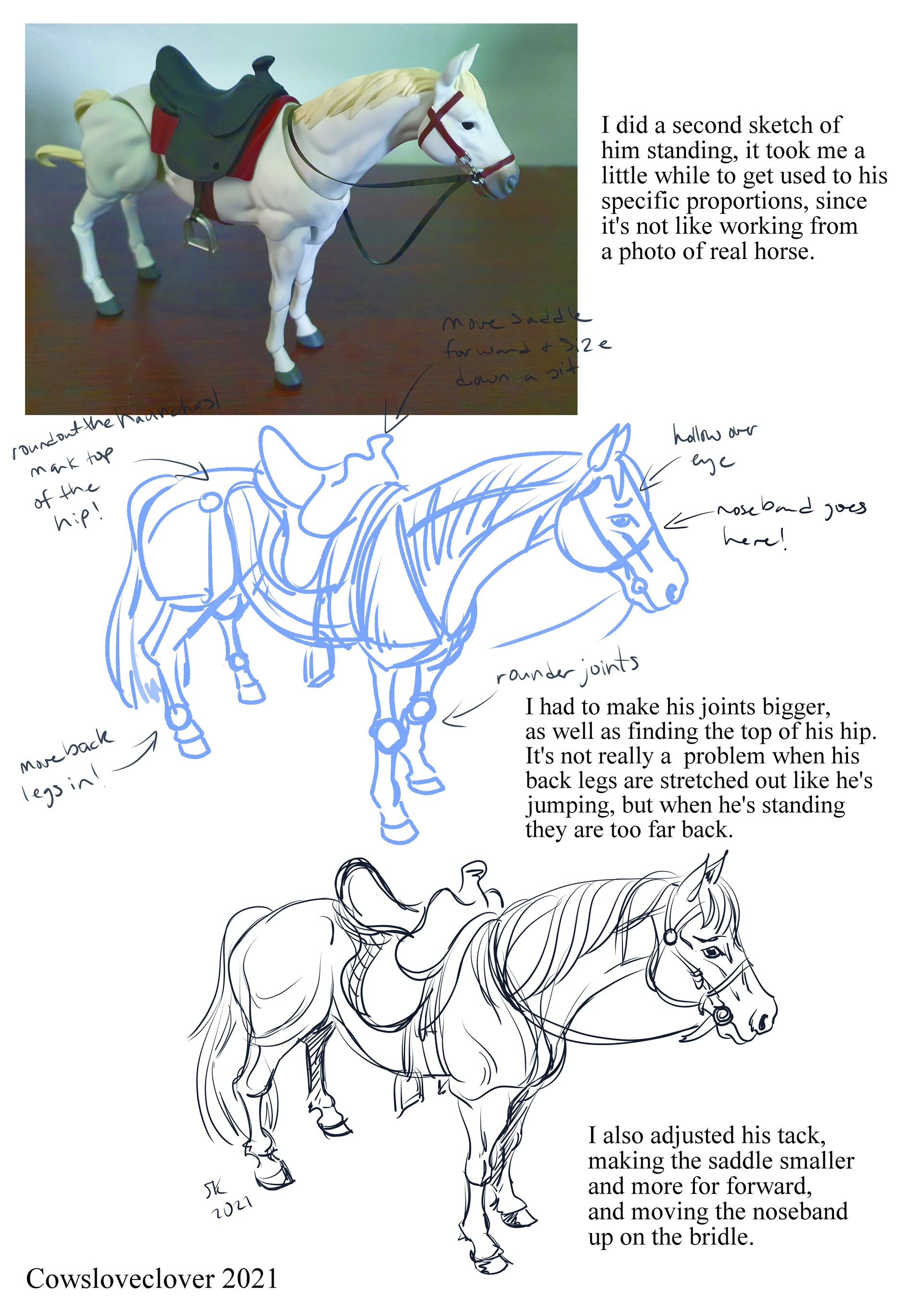
First of all, the anatomy and proportions of this model are reasonably good, although not perfect. Any horse will have some variation based on that individual animal and its breed, but this model has a few points that I think aren't really accurate, especially compared to other horse models on the market such as the Collecta, Breyer or Schleich models. These models aren't articulated but they are the same price or quite a bit cheaper, depending on the size, and generally more anatomically accurate. I feel like his head and neck are a bit too small and that his hindquarters are a bit too high. My other immediate impression was that his hind legs are a little bit too long. When he's positioned standing on all four legs, his hind legs have to be set quite far back. He has a very general look and doesn't resemble any particular breed or type of horse.
His head looks good from the side but from the front his back jaw is a little bit wide. Horses have eyes that are set out a little bit more from their skull in order to allow them nearly 360-degree vision. Some horses have proportionately wider heads, especially draft breeds, but it's a common mistake to draw a horse’s jaws as wider than his eyes and here the artist has definitely done that. From the front a horse’s eyes should make the outermost points of a diamond shape and the jaw should not be visible on either side of them. His nose is well modeled, I think his mouth looks quite good. It really does look to me like how a lot of artists draw horse heads when they aren't familiar with how horses look in life.
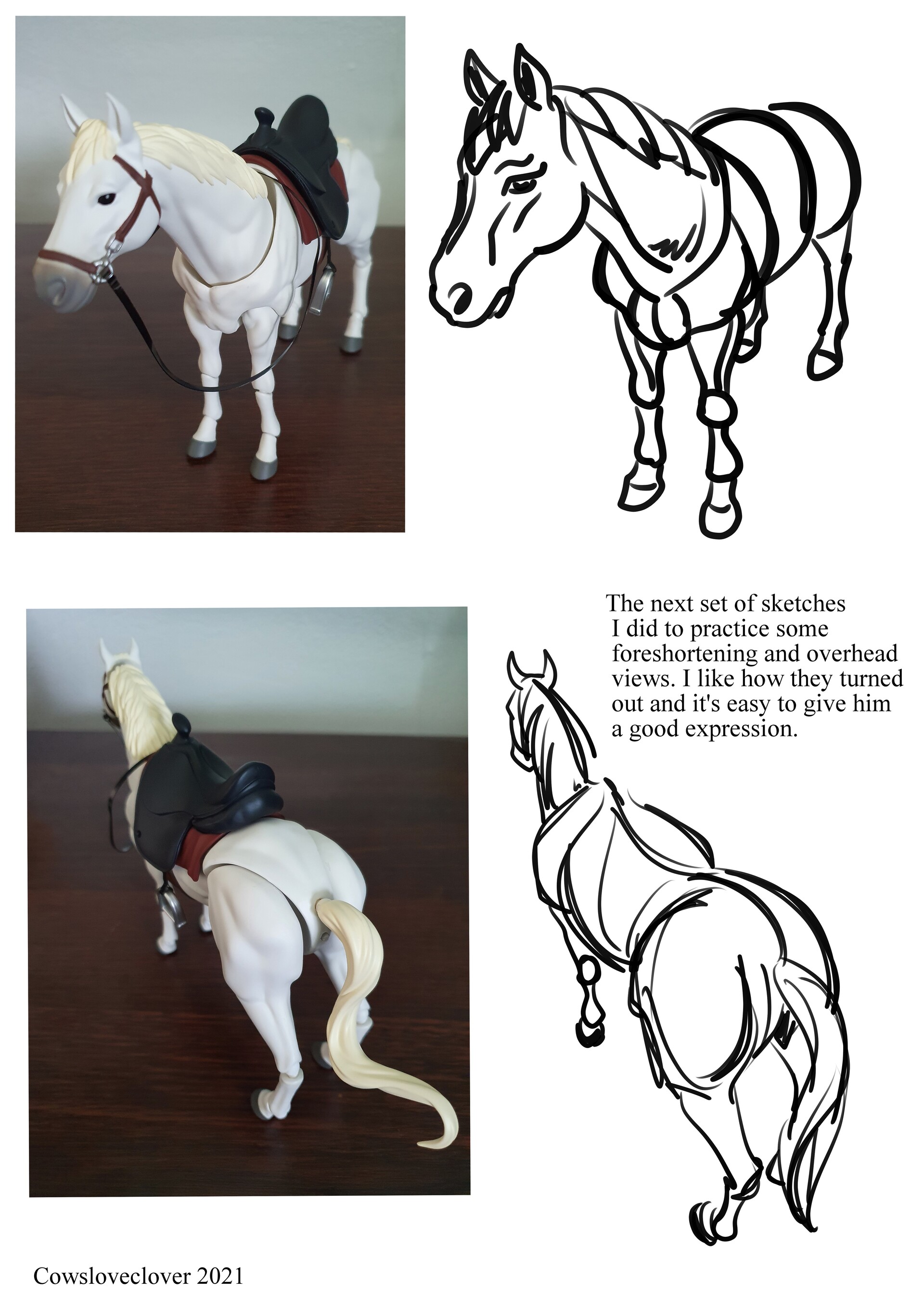
He doesn't really have any withers, that is the high point right at the base of his neck, but this has been covered with the articulation and the saddle, so I'm not too upset with that. His front legs look very good. Over his rump there's a weird triangular shape. It seems like the artist who modeled this thinks that there is some sort of triangular bulge like what humans have over the lumbar where the torso comes down to meet the pelvis. Horses don't have that bulge. They are smooth over the back and rump, so I find this very strange. You can see how it should look just by checking photos of horses. There is no triangular bulge over the hips and the rump so I'm not really sure where this came from.
Like I said before his back legs seem a little bit long. They don't really sit under his body the way they should but maybe also part of the articulation. I don't make articulated models so I want to give a little leniency here. As for his articulation I think it's fine, the head doesn't move very far, just a bit from side to side and the neck can move from side to side, and a little up and down. I would have liked to have seen him be able to take his head all the way down. Sadly, no grazing for him. His front legs have good articulation and can take a very natural position. I think he could use one more joint of articulation at the femur where it connects to the patella, that is the joint where the horses leg starts to move independently of its body, right behind the groin. It's basically the horse’s knee and has a lot to do with how the horse moves his hind legs. I think it would have just allowed him to be a bit more posable but again I don't build these models, so I don't know how much space there is in the joint for a model this size. The horse does stand on his own for legs, it's a little bit tricky to get him to stand on three and he can't stand on two. He does have a base that he comes with, and it has pegs that fit into a hole on his belly and a hole under his tail. This should allow him to make more poses. The base does support him in a jumping position, but when I tried to get it in under the tail to put the horse into a rearing position the peg broke, so I don't know how successful that is in real life. He is a heavy model and to get him to do positions like jumping or rearing you'll either have to hold him and take a photo or you'll have to rely on the base. So, for poseability I would give him maybe a 7 or an 8 out of 10. I find that his mane looks alright, but this model doesn't have a really natural tail. A horse has over ten tail vertebrae, very much like a dog and their hair grows off this, so this tail doesn't look very natural at all. His mane and forelock look more natural, it kind of makes me think he has shounen at the front and shoujo hair in the back, sort of like an anime mullet.
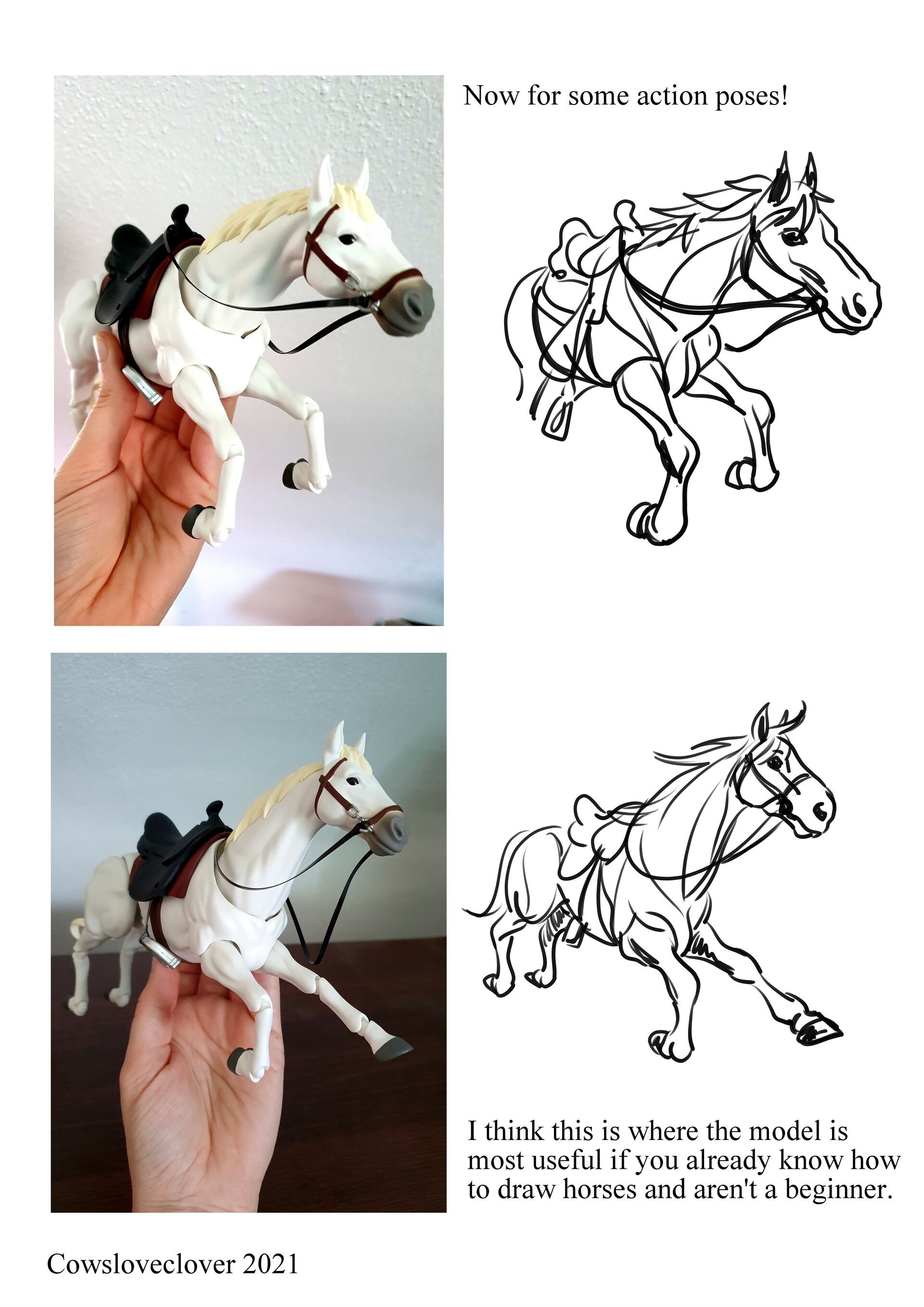
His hooves actually look really good! I think they're modeled quite well and I like that there is a joint on the pastern bone so his hooves have more movement than just sitting at the end of the straight leg. There's a wooden articulated test artist’s model I see on Amazon or in art shops that models pasterns and hooves don't have the articulation of this one. I'm not sure what the artist was looking at! It's interesting because in the first version of this model, the musculature seems to be more smoothed out. It seems like they wanted more detail but actually it looks a little strange if you are very familiar with horses.

The second point I have is about his tack. It looks like they tried to give him a typical English hunter bridle but again, I think it's clear the artist didn't really understand how bridles work as the nose band is way too low and should go up to sit more in the dent of his nasal crest and the noseband shouldn't be directly connected to the bit. The other interesting thing about this model is the saddle in the photos of the first version is clearly an English or dressage saddle with the girth set directly behind his front legs. However, in this model the horse is wearing a different saddle and his girth is in a different position. I wasn't initially sure what kind of saddle this was meant to be but after asking in my horse art group the consensus was that this is an endurance or trail riding saddle. It should be clear that this is not a western saddle. Not only that the saddle is actually a bit too big (something else the group agreed upon) and is set too far back, the biggest problem is that the girth is now sitting over the largest part of the horse's belly! This is totally incorrect and dangerous, as from this position the girth will simply slip off forwards or backwards and the entire saddle and rider with it. The cinch always goes directly behind the horse’s front legs and I'm not sure how this mistake was made, since I'm 100% sure there are no reference photos showing a cinch or a girth in this position. The first version of this horse was more accurate there.
All in all, I think this is not a bad model, but it definitely needs to be supplemented by further studying horse anatomy and having references for equipment, if you don't already know how tack works. I'm not unhappy with the model but I'm glad I didn't pay full price for him. I think if you were only drawing horses only a little bit, he would be a bit of an extravagant purchase and you could probably just rely on photos to do your work, but if you're someone like me who draws a lot of horses or you have a project that requires a lot of horses from different poses, then I think he's quite useful, especially for taking your own reference photos. An artist can save a lot of time by being able to take their own photos from various angles rather than having to search online. I know from my own work that it can be very difficult to find certain shots of a horse, say from underneath the head or directly overhead or with extreme foreshortening, so I think he was a good purchase. I would stress that it's important to do your own studies of horses, from life ideally or from a variety of photographs so that you have a good enough knowledge of horse anatomy to work with this model and not copy the mistakes of the sculptor. I think he's a really cute addition to my herd and while I have seen and even own models with more articulation, I do really like him. Overall, I'll have to give him a seven out of 10. If he had slightly better proportions and a little bit more accurate musculature, I would give him another point. I do have to take a full point away for his tack because there's absolutely no saddle set up where the girth was on that position, unless it was a how not to saddle your horse tutorial. It's not clear to me if the sculptor was referencing photos or referencing another artwork. I think he'd be a very good purchase if you got him on sale or again if you're going to be drawing a lot of horses, and you want to be taking your own reference photos. Unfortunately, I'll have to buy another stand, but for the moment he's alright on the windowsill with the rest of my models.